
Robot Factory Digital Twin
This project explores how a simulation-ready manufacturing environment can be designed around the robot, rather than simply modeled as a visual representation of a factory. I built the environment using OpenUSD and NVIDIA Isaac Sim, organizing the factory as a modular digital twin where equipment, work areas, materials, sensors, and robotic systems can be independently configured and simulated.
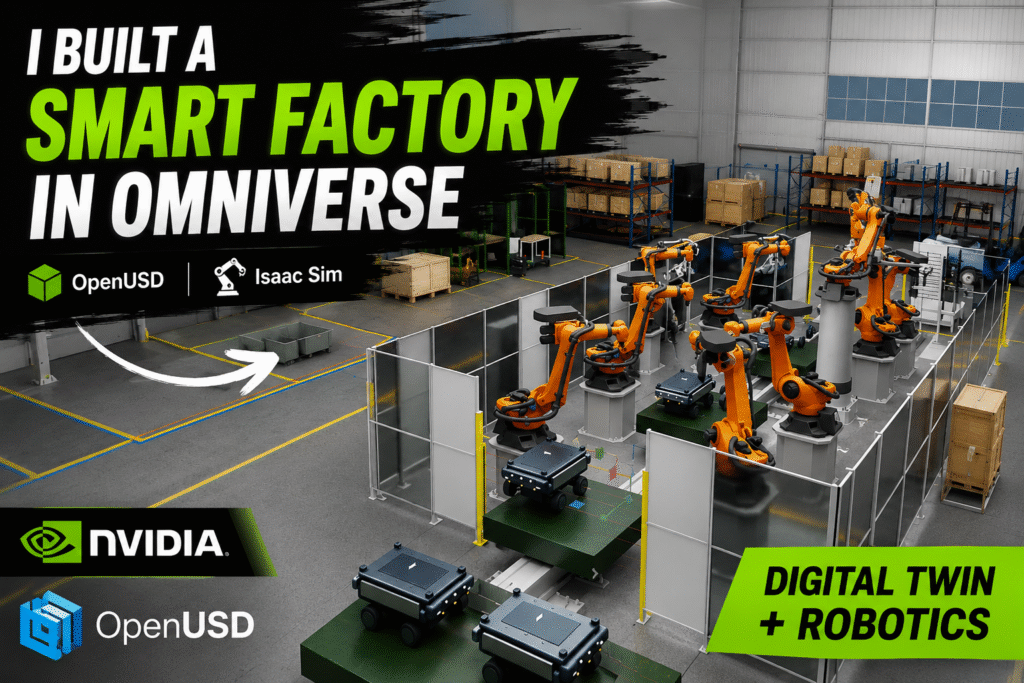
At the center of the project is Muvy, a modular mobile robot platform I developed to experiment with autonomous movement and sensor-driven behavior. The robot uses simulated cameras and LiDAR, differential-drive locomotion, and ROS 2 sensor integration to navigate and interact with the factory environment. This allowed me to work not only on the 3D environment itself, but also on the relationship between robot geometry, physics, collisions, joints, sensors, and the surrounding workspace.
The factory is structured around a manufacturing workflow, including areas for material receiving, fabrication, welding, assembly, and packing. Using OpenUSD makes these components modular and reusable, allowing individual assets, robot configurations, or factory layouts to evolve without rebuilding the entire scene. The environment can therefore serve as a foundation for testing navigation, evaluating workflows, collecting simulated sensor data, and eventually training autonomous robotic behaviors.
The project represents my approach to digital twins as functional simulation systems rather than static 3D models: combining environment design, OpenUSD scene architecture, physics, robotics, sensors, and software into a space where real operational questions can be explored before deploying systems in the physical world.