
What if the greenhouse itself were the robot?
Lorem ipsum dolor sit amet, consectetur adipiscing elit. Ut elit tellus, luctus nec ullamcorper mattis, pulvinar dapibus leo.
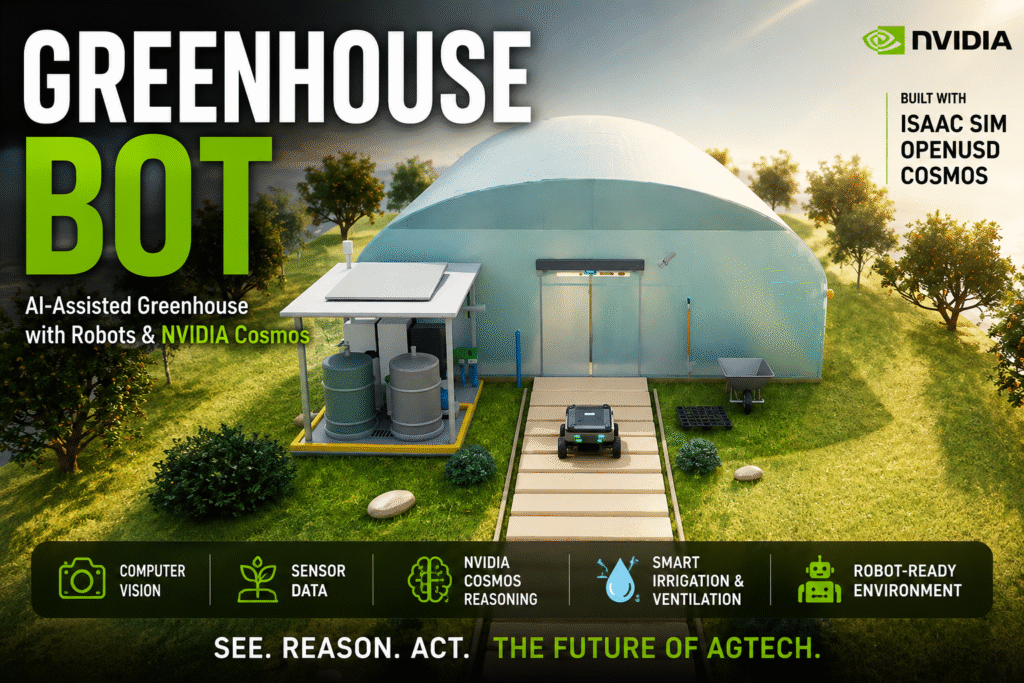
I built this project to explore how digital twins, physical AI, and computer vision can work together to manage a real agricultural environment.
The project is based on a 35 × 50 ft greenhouse, modeled as a simulation-ready environment using OpenUSD and NVIDIA Isaac Sim. Rather than treating the greenhouse as a static 3D visualization, I designed it as an interactive system where sensors, environmental conditions, mechanical devices, and AI reasoning are connected through a single simulation.
The greenhouse includes simulated temperature, humidity, and soil-moisture sensors, along with controllable systems for irrigation, ventilation fans, doors, and roll-up greenhouse walls. I developed a custom Omniverse/Isaac Sim extension that provides an interface for monitoring these systems and controlling the greenhouse directly from the simulation.
The next layer introduces NVIDIA Cosmos Reasoner as an AI decision-making component. Camera observations and environmental data can be passed to the reasoning pipeline, allowing the system to interpret conditions inside the greenhouse and determine appropriate actions. Instead of relying only on fixed thresholds, the goal is to explore how a vision-language reasoning model can identify situations such as plant stress or changing environmental conditions and connect those observations to actions in the digital twin.
This creates a complete workflow:
Environment & Sensors → Isaac Sim → Custom Omniverse Extension → AI Reasoning → Greenhouse Actions
The project also serves as a foundation for robotics and autonomous agriculture. Because the greenhouse is built as a structured OpenUSD environment, it can later be used to simulate cameras and robotic systems, generate synthetic data, and develop tasks such as navigation, plant inspection, harvesting, pruning, and greenhouse maintenance.
What started as a greenhouse visualization evolved into an experiment in building a simulation-first intelligent system—connecting 3D environments, sensor data, computer vision, AI reasoning, and physical control within the NVIDIA simulation ecosystem.